
Quantitative Reasoning is the ability to manipulate, analyze, and/or evaluate numbers and numerical data. It may involve calculation and/or analysis, and interpretation of quantitative information derived from existing databases or systematic observations, and may be based in a variety of disciplines, not limited to mathematics and the natural and physical sciences (SCHEV Definition).
Learning Opportunities
Quantitative Reasoning is taught and assessed through Mason Core courses. Quantitative Reasoning courses equip students with critical thinking skills using mathematical and statistical concepts (i.e., formulas, graphs, tables, models, and schematics) to analyze and make sense of data, patterns, and relationships.
Data Collection and Reporting Schedule
Instructors teaching Quantitative Reasoning courses are required to address Quantitative Reasoning learning outcomes and submit student artifacts demonstrating achievement of the student learning outcomes.
Student artifacts collection occurred in Fall 2022 and concluded in Spring 2024. The collected student artifacts were rated and analyzed in Spring 2025. The assessment report was published in Spring 2025.
- Upcoming Data Collection: Fall 2027-Spring 2028
- Upcoming Mid-Cycle Report: Fall 2029
Assessment Report(s)
Latest assessment report published in Spring 2025.
Quantitative Reasoning Assessment Report (Spring 2025)
Examples of Quantitative Reasoning affiliated learning outcomes and their assessment findings at the program level in AY 2025.
Learning Outcomes
Interpret quantitative information (i.e., formulas, graphs, tables, models, and schematics) and draw inferences from them.
Sample
Undergraduate degree-seeking students enrolled in QR courses during the 2022-2024 assessment period. Student artifacts from the 2022-2024 assessment period were randomly selected using a process designed to ensure all learning outcomes and sections were represented.
- 443 sections enrolled
- 19,414 students enrolled
- 1,756 artifacts submitted
- 241 artifacts assessed
Measure
The data collection includes submission of syllabi, assignment descriptions, and at least three randomly selected student artifacts from each instructor for courses under review within the category. From those submissions, a stratified random sample of artifacts is selected for a representative evaluation of student performance.
Target
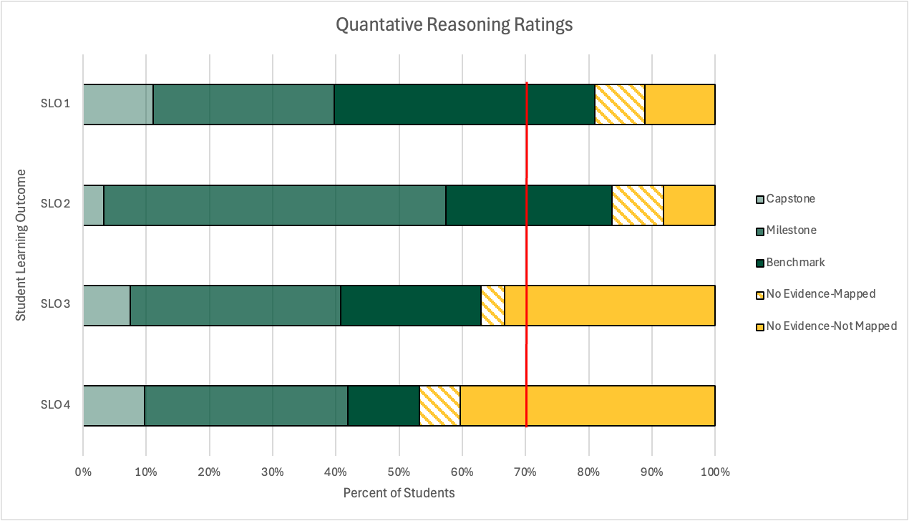
Artifacts rated as Capstone, Milestone, or Benchmark were considered as meeting the learning outcomes. A baseline target of 70% was established in this round of assessment. Targets can and will be modified as both assessment processes and continuous improvement efforts are implemented.
Findings
The target of 70% was met for SLOs 1 and 2, but not for SLOs 3 and 4.
Next Steps
The Mason Core Committee (MCC) reviews the findings to ensure its continued effectiveness and alignment with institutional goals. Results are shared with faculty, programs, departments, and at the institutional level to facilitate meaningful discussions and decisions about improvements to the category under review. Further, to support continuous improvement, OIEP, in partnership with the Stearns Center for Teaching and Learning, collaborates with MCC and faculty to offer professional development.
Formulate a given problem quantitatively and use appropriate arithmetical, algebraic, and/or statistical methods to solve the problem.
Evaluate logical arguments using quantitative reasoning.
Communicate and present quantitative results effectively.